
Why do we find one place appealing and are uneasy in another? Why are
we attracted to one product over another? Color—whether architectural
or in products—accounts for 60 percent of our response to an object or a
place.
The "buzz" about color is usually called "color psychology." But the
effects of color are subtle and significant; physical and psychological.
Color use is not something that results in a definitive equation
between "color and our moods," as is a currently popular expression.
Wherever we go we respond to color, but the importance of color is often
underestimated. Color use is important to us personally in our homes
and in the places where we work.

HGTV's Top Color Picks
Check out our favorite "color of the month" ideas from the past few years.
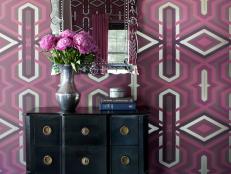
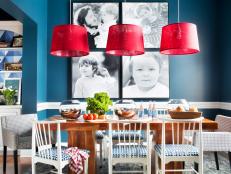
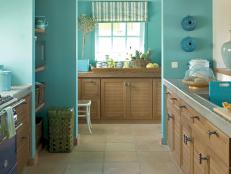
Start Small
If you're not sure where to begin with color, experiment in a powder
room or bathroom, a small hall or area between rooms, or an accent wall.
If you're doing your own painting, pick an area that's quick to do so
you can see your results sooner, and be happy with it or change it. Look
at the process as an adventure.
To get started, select a favorite color drawn from artwork, a rug,
dishes and an accessory or furniture piece as a main color or accent.

Think About Your Mood
When selecting a color, consider the mood of a room. In a bedroom do
you want the feeling to be restful and soothing or dramatic and
intimate? Soft, cool colors and neutrals usually create a quieter
feeling while stronger colors are for drama.
Do you want a dining area to feel sociable and stimulating or appear
formal and quiet? Warmer, contrasting and somewhat brighter colors add
to a sociable atmosphere; deeper blue-greens and neutrals will give a
more formal ambiance.
Do you want kid's rooms to create an active and exciting energy or an
orderly and restful feeling? Be careful not to overstimulate your
children with intensely bright hues. You may not know it, but some
brighter colors can lead to unrest and irritability.
Pay Attention to Lighting
The reason why paint stores have light boxes for you to test paint chips:
- Natural daylight shows the truest color;
- Incandescent lighting brings out warm tones and yellows;
- Fluorescent lighting casts a sharp blue tone.
So, a strong color might be too bright and overpowering when used on
all walls or next to a large window, but it might be effective when used
as an accent wall with indirect light.

A red wall, symbolic of good luck in Chinese
tradition, anchors this living area. Low, neutral furniture with
built-in side tables sits above a silk handmade Cha-Cha rug by
Formaonline.com. Artwork by the architect provides a finishing touch.
Learn the Color Terms
It helps to understand the terminology used to describe color.
- Hue is what we call a color. Red is the hue; blue is the hue.
- The value of the hue is how light or dark it is.
- Saturation refers to how dominant the hue is. As we go from red to pink, the red hue becomes less dominant.
- Intensity is the brilliance of the color. The pure colors such as
red are more intense than the combined colors such as yellow-green. A
stronger intense color usually has a more dominant hue.
If you want a more active space, consider introducing stronger, more
intense color. Even if you want a light-colored room, choose colors that
are slightly more saturated than off-white or light pastel. Very light
color can feel bright and stark when it appears on all surfaces in a
room. However, two or more medium-light, closely related pastel colors
can create a luminous effect when used in the same room.

This traditional-style living room features an
ornate carved fireplace and mantel, a damask-patterned sofa and an
upholstered chaise lounge to complement the space.
Test Your Color Choice
Boost your confidence by testing colors on poster board or large
areas of a wall. Don't be afraid to go beyond your comfort zone:
Consider strong, vivid colors or soft, deep neutrals like chocolate
brown or olive green as main or accent colors. Or add drama with a
stronger color on the ceiling. Tinted ceilings can dramatically change
the whole look of a room.

When New York designer Sherrill Canet created a
living room for the 2006 Kips Bay Show House, she custom-blended a
malachite green paint with a mahogany glaze finish. Photo by Tim Lee
Add Depth With Decorative Finishes
Transform flat, dull walls into interesting and personal spaces with
subtle or dramatic visual texture and broken color. Burnished
mineral/metal finishes and layered colored glazes add depth. Some
examples of softly reflective metals are mica, copper, pewter, bronze
and, of course, antiqued silver and gold.

This cool living room area features a curvy
white sectional with blue and brown throw pillows. The couch sits on top
of a gray carpeted floor and in front of the brown walls that feature
nature decor.
Walk Into Another Room
Consider walls as planes of color, and see how they interact when
viewing one next to the other in adjacent rooms. Approach it like a
composition: You're in one room, but you're going to see a piece of
another room through it. So as you're choosing colors, consider how they
will flow from room to room to create your picture.

Follow the Color Wheel
A small color wheel is a great reference tool for modifying and
intensifying two or more colors. For example, red and green, which are
complementary (opposite) colors, are most intense when used together.
You may be surprised at how many combinations function beautifully
together, and you may even become attracted to entirely new color
palettes. The color wheel also illustrates the visual temperature of a
color. Draw a line from the yellow-green mark on the color wheel all the
way down to the red-violet; you'll see that all the colors on the left
are warm and the colors on the right are cool.

Number one color rule for a small space? There are no rules! Mixing colors can help bring a personal touch to your space.
Play Up Monochromatic Schemes
Think one color is boring? Create bold or subtle variations within
one color group with contrasting paint finishes. For example, use
closely related colors, or try a single color in different finishes, for
walls and trim in one space.
For an accent color, select a warmer (more toward reds) or cooler
(more toward blues) color to complement your main color group. For a
quieter ambience, make sure your colors are not extremely bright. White
or an off-white tint can be a striking accent when used as trim with a
monochromatic color group.

White or an off-white tint can be a striking accent when used as trim with a monochromatic color group.
Choose Different Paint Finishes
A single color used on walls and trim takes on new significance when
applied in different finishes. For example, wall and trim colors can
remain the same hue, but use an eggshell (matte and less reflective)
finish on walls and a satin or semigloss on trim. The color will appear
slightly different on each surface. It's a good way to create a cohesive
look in rooms with many windows and doors, and relatively little wall
area.

A great way to create a cohesive look in rooms
with many windows and doors, and relatively little wall area is to
choose different paint finishes for wall and trim.


0 comments:
Post a Comment